How event organisations shape a city’s response to crisis

The crowd at the Ray-Ban stage, Primavera Sound, Barcelona, 1 June 2019. Photograph by John Lubbock, via Wikimedia Commons, licensed under CC BY-SA 4.0.
During the drought in Cape Town, the city’s international convention centre faced a problem familiar to many of its residents and businesses. How much water could it save, and where else could it get the water it needed? The centre cut its consumption and invested in a reverse-osmosis plant designed to supply up to 200,000 litres a day. For the people running the venue, this was a way to keep it operating during a severe shortage. For everyone else drawing on Cape Town’s water supply, the significance was that one of the city’s major venues could now meet more of its own needs.
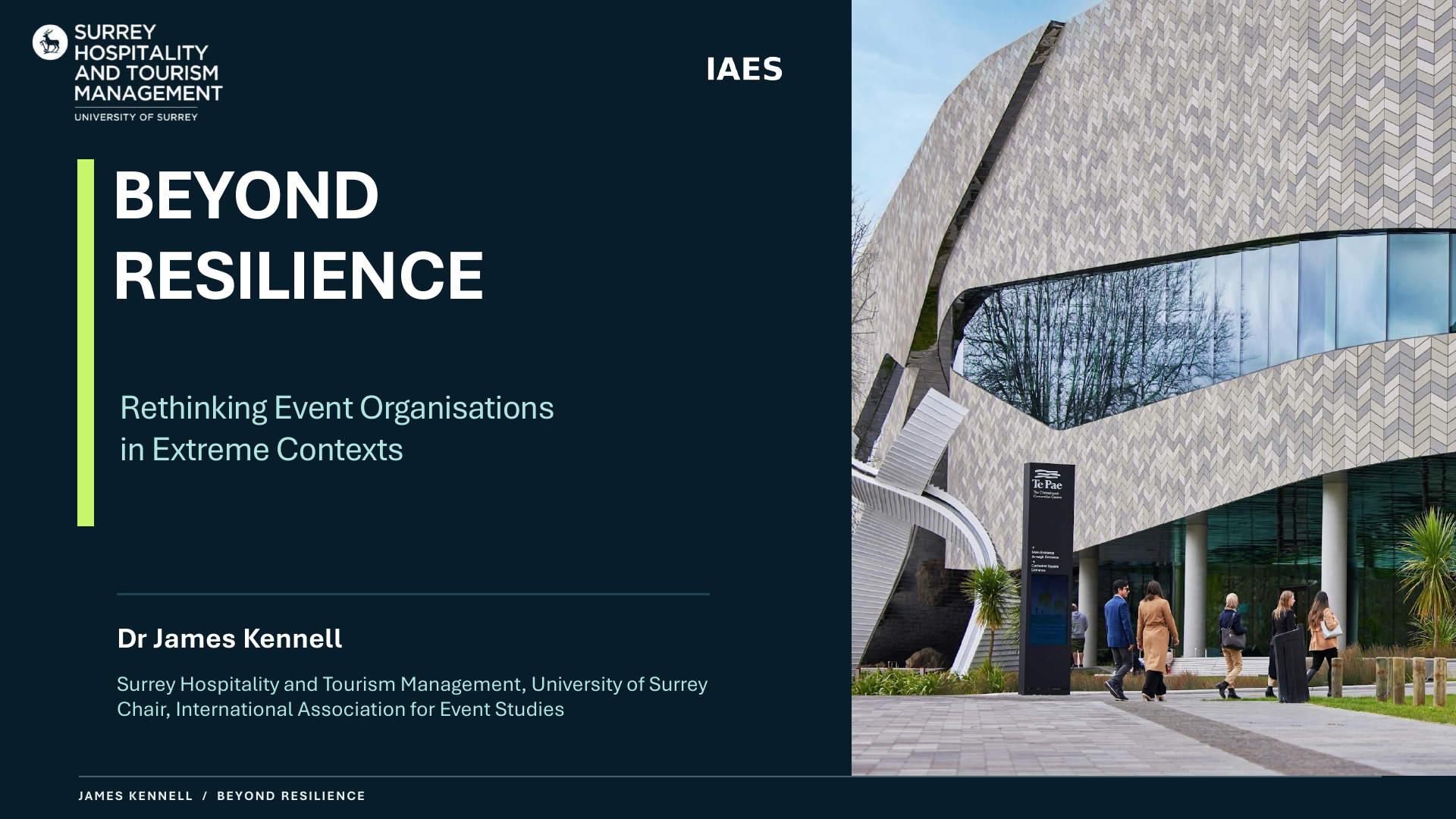
Cape Town was one of four examples I discussed in my keynote, Beyond Resilience: Rethinking Event Organisations in Extreme Contexts, for an events industry audience in Yiwu, China, on 20 November. In events research, we often use resilience to describe how organisations cope with disruption and adapt to difficult circumstances. In my work with colleagues at Surrey and overseas, we are also interested in the influence that event organisations have on those circumstances. A decision taken by a venue manager, a festival director or a race organiser can change the options available to other people facing the same crisis.
In Barcelona in December 2020, one of the questions facing live music organisers was whether audiences could gather indoors safely during the pandemic. The organisers of Primavera Sound worked with medical researchers to stage a concert at Sala Apolo as part of a randomised controlled trial. Participants took a rapid antigen test before being allocated either to attend the concert or to join a control group. Eight days later, researchers detected no infections among the 465 concertgoers included in the analysis and two among the 495 people in the control group. The findings, published in The Lancet Infectious Diseases, gave other organisers and public health authorities evidence about the particular conditions tested in Barcelona. Primavera Sound’s contribution was its ability to put on a live show under conditions that allowed the researchers to study it.
In Christchurch, the relationship between events and recovery unfolded over a decade. Following the 2011 earthquake, the city’s recovery plan included a new convention centre as one of the projects intended to bring people and investment back into the centre of Christchurch. Te Pae opened in December 2021 and welcomed its first conferences the following year. By then, decisions about where delegates would meet, stay and spend time had become part of a much larger set of decisions about how to rebuild the city.
The organisers of the Valencia Marathon had just over a month between the floods of October 2024 and race day on 1 December. Some residents and runners questioned whether it was appropriate to hold the marathon while neighbouring communities were still recovering. The race went ahead, and its organisers used their relationships with runners, sponsors and international partners to raise more than €1 million through Valencia Runs 4 Valencia. The money supported local athletics clubs, helped replace equipment and contributed to rebuilding damaged sports facilities. People could reasonably disagree about the decision to hold the race while recognising what those funds made possible.
In the keynote, I argued that we need to study how event organisations influence the extreme contexts in which they operate. The organisers of Primavera Sound helped researchers investigate the conditions under which indoor concerts could take place during the pandemic. In Valencia, the marathon organisers drew on their relationships with runners and sponsors to fund repairs to sports facilities after the floods. In each case, people working in events had skills and relationships that others could draw on in responding to the crisis. For those of us researching event organisations, this raises questions about when they are able to exercise that influence, how they do so and what consequences their decisions have for others over time.


Comments